
Some questions sound almost too simple to matter, yet once you start unpacking them, they reveal how much of what we take for granted is actually built on human decisions. “What time is it at the poles?” is one of those questions, because at the very top and bottom of the planet, the rules we rely on every day stop working the way we expect.
Where the logic of time breaks down
Across most of the world, time is tied to the Sun and to a system of time zones based on longitude. Everything is anchored to a global reference point—Coordinated Universal Time—and then adjusted depending on where you are.
At the North Pole and the South Pole, that system essentially collapses. All lines of longitude meet at a single point, which means that, in theory, you’re standing in every time zone at once.
In other words, there is no naturally “correct” local time. Time stops being something determined by geography and becomes something people simply decide on.
The North Pole: time as a pure convention
There are no permanent settlements at the North Pole—just shifting ice over the Arctic Ocean and the occasional research or exploration team passing through.
Because of that, there’s no official time standard. Each expedition chooses whatever works best. Some stick to Coordinated Universal Time to avoid confusion, while others keep the time of their home country or their support team.
Two groups standing not far from each other could technically be operating on completely different clocks, and it wouldn’t cause any real issue.
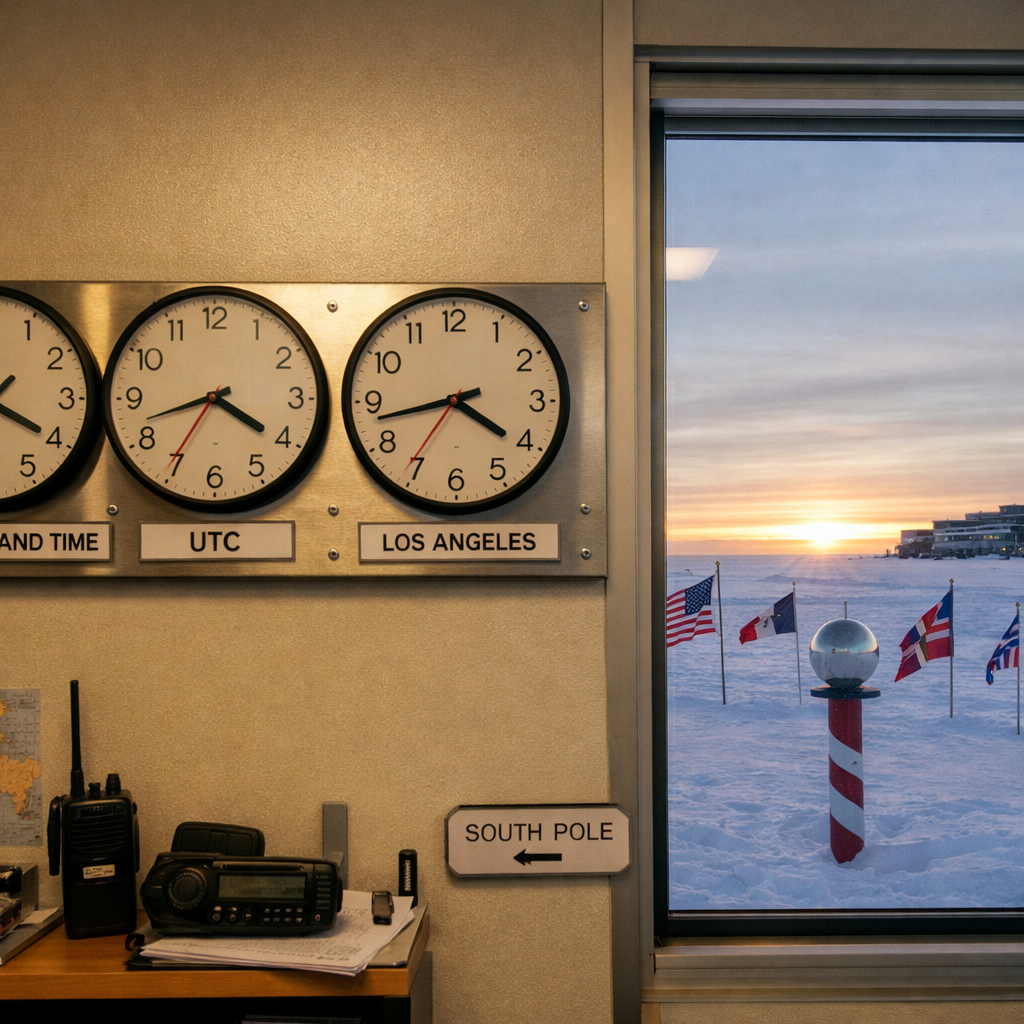
The South Pole: choosing time for practical reasons
Things are a bit more structured at the South Pole, where permanent research stations exist. The most well-known is the Amundsen–Scott South Pole Station.
There, time isn’t chosen based on geography, but on logistics. The station follows the time used in Christchurch, because most supply flights and operational coordination come from that region.
Other research stations across Antarctica follow the time zones of the countries that run them, which means multiple “local times” can exist on the same continent at once.
A detail most people overlook
Antarctica doesn’t belong to any one country in the traditional sense. It’s governed by international agreements, and because of that, there’s no single official time zone for the entire continent.
Each station operates on whatever schedule makes sense internally, and that flexibility is not a flaw—it’s what allows the system to function.
When day and night disappear
Time becomes even more abstract at the poles because the normal cycle of day and night disappears.
At both the North Pole and the South Pole, the Sun can stay above the horizon for about six months and below it for another six. Without daily sunrise and sunset, there’s no natural rhythm to anchor time.
As a result, everything—sleep, work, meals—is scheduled strictly by the clock, not by light.
The conclusion that shifts perspective
The question “what time is it at the poles?” doesn’t have a single answer, because in that place, every answer can be valid.
Time, which feels fixed and universal in everyday life, becomes something flexible—something shaped by human needs rather than dictated by nature. And that realization doesn’t just change how we see the poles, but how we think about time itself.