
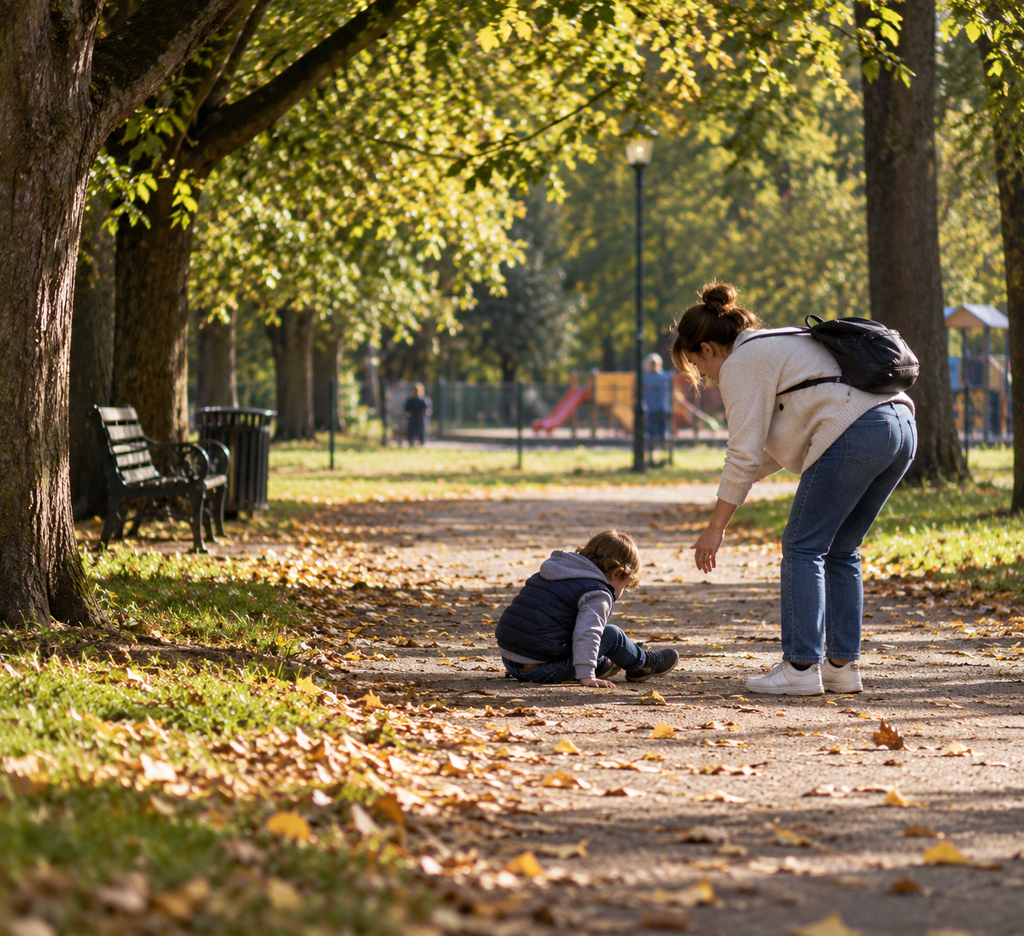
A toddler is running, trips, and falls.
For a brief second, there is no crying. The child freezes, looks at the floor, then turns toward the parent.
Sometimes the reaction seems almost immediate. If the adult gasps, rushes forward and says, “Oh no, are you hurt?”, the child’s face may suddenly collapse into tears. If the adult stays calm and gently asks, “Are you okay?”, the child may simply get back up and keep playing.
Many parents have noticed this moment and wondered whether children actually wait to see how adults react before deciding what to feel.
Psychologists have been studying a closely related phenomenon for decades.
It is called social referencing, and it describes the way young children use another person’s emotional reactions as information when they are unsure how to interpret a situation.
In other words, when a child does not yet know whether something is safe, threatening, strange, or harmless, they may look to a trusted adult for clues.
Children learn from our reactions before they understand our explanations
Young children have very little experience with the world.
They do not automatically know whether an unfamiliar animal is dangerous, whether a loud noise is something to fear, or whether a strange-looking object is safe to touch.
In uncertain situations, a familiar adult can become an emotional reference point.
The child notices the adult’s face, tone of voice, posture and behavior, then uses those signals to help decide what to do next.
This does not mean the child consciously thinks, “Mom looks afraid, so this must be dangerous.”
The process is much more intuitive.
The child sees something unfamiliar, checks the adult’s reaction and adjusts their own behavior accordingly.
That simple sequence turns out to be surprisingly powerful.
The famous “visual cliff” experiment
One of the best-known demonstrations of social referencing was published in 1985 by researchers James Sorce, Robert Emde, Joseph Campos and Mary Klinnert.
They studied 108 infants around 12 months old using an experimental setup known as the visual cliff.
The child was placed on a surface that appeared to end in a sudden drop. In reality, a strong transparent surface covered the apparent gap, so the babies could move across it safely.
The important part was that the situation looked uncertain.
It was not obviously safe, but it was not so frightening that every child would automatically refuse to continue.
The mother waited on the other side.
When the infant reached the apparent edge and looked toward her, she displayed one of several emotional expressions, including happiness, interest, fear or anger.
What happened next was striking.
When mothers showed happiness, about 74 percent of the infants crossed.
When mothers showed interest, the proportion was similarly high.
But when mothers displayed fear, none of the 17 infants in that condition crossed the apparent drop.
When mothers showed anger, only a small minority continued.
The “cliff” had not changed.
What changed was the emotional information coming from the parent.
The most important factor was uncertainty
The experiment revealed something deeper than simply “babies copy their mothers.”
The emotional signal mattered most when the child was uncertain.
When the situation did not contain the same ambiguity, children relied far less on the parent’s facial expression.
That distinction is important.
Children do not constantly need adults to tell them how to feel.
Social referencing becomes particularly useful when their own information is not enough.
The child’s glance toward the parent is almost like a question without words:
“I’m not sure what this means. What do you think?”
Children are not only reading faces
Facial expressions are only one part of the message.
Research has also shown that infants use vocal emotional cues.
A parent may say perfectly reassuring words while their voice, posture and body language communicate something completely different.
Think about how adults react when they are genuinely worried.
The voice changes.
The shoulders tighten.
The body moves backward.
The child is pulled closer.
The adult’s eyes widen.
Even without an explicit warning, the child receives a large amount of emotional information.
Young children are sensitive to these signals because, from a developmental perspective, they are useful.
A child does not need to personally discover every danger in the environment.
Learning from trusted adults is far safer.
Can children actually learn fear from their parents?
This question has become increasingly important in developmental psychology.
A systematic review and meta-analysis published in 2023 examined research on the transmission of fear from parents to very young children through observation and modeling.
The researchers identified 23 relevant studies, with 19 included in the statistical meta-analysis. The children studied were up to 30 months old.
Overall, the results showed that when parents displayed fearful or threatening reactions toward a new stimulus, children were more likely to show fear and avoidance themselves afterward.
The effects were not enormous, but they were meaningful.
The findings support the idea that young children can learn something about danger simply by watching how trusted adults respond.
Fear, in other words, is not learned only through direct experience.
Sometimes it is learned socially.
But one frightened reaction does not “traumatize” a child
This is where social media often turns an interesting psychological finding into something much more dramatic.
Claims such as “your child saw your fear and will remember it forever” or “one anxious reaction creates lifelong fear” are not supported by the evidence.
Parental reactions can influence a child.
That is not the same as saying that one facial expression creates a phobia, an anxiety disorder or permanent trauma.
Emotional development is much more complicated.
A child’s temperament matters.
Repeated experiences matter.
The intensity and frequency of the parent’s reactions matter.
What the child later experiences directly matters.
The behavior of other trusted adults matters too.
Children are influenced by us, but they are not passive copies of our emotions.
So what about the child who falls and looks at the parent?
This familiar parenting moment fits well with what researchers know about social referencing, but it should not be oversimplified.
If a child falls and it hurts, the child may cry regardless of what the parent does.
If the fall is frightening, crying is normal.
And if the child is genuinely injured, the adult should obviously respond immediately.
But when the fall is minor and the child is unsure what just happened, the adult’s reaction can become another piece of information.
A child may look at the scraped knee, then at the parent, then back at the knee.
If the adult reacts with immediate alarm, the child receives the message that something serious may have happened.
If the adult stays calm and checks carefully, the message is different.
Remaining calm does not mean dismissing the child.
It means avoiding unnecessary panic before knowing whether the situation actually requires it.
The same thing can happen around animals, strangers and unfamiliar places
Imagine a young child seeing a large dog for the first time.
The child stops.
Looks at the dog.
Then looks at the parent.
If the parent suddenly stiffens, pulls the child backward and speaks in a frightened voice, several signals of danger are being communicated at once.
If the parent remains calm while keeping a sensible distance and explaining what is happening, the emotional message is different.
This does not mean children should be encouraged to approach unfamiliar dogs.
Real safety rules still matter.
But there is a difference between caution and panic.
Children can learn both from the adults around them.
The same process can occur with unfamiliar people, medical settings, loud noises, playground equipment or almost any situation the child does not yet know how to interpret.
Sometimes a parent’s fear is exactly the lesson a child needs
Social referencing should never be interpreted as an argument for parents to hide every negative emotion.
That would be unrealistic and potentially unhelpful.
Fear has a biological purpose.
If a child runs toward traffic, a sharp warning is appropriate.
If they reach toward a hot surface, urgency is useful.
If there is genuine danger, the child should receive a clear message that the situation is unsafe.
The ability to learn from another person’s fear is protective.
The problem is not that children sometimes see adults afraid.
The more relevant question is whether they repeatedly receive danger signals in situations that are actually safe.
A parent who constantly says:
“Don’t climb, you’ll fall.”
“Don’t touch that.”
“Don’t go over there.”
“Be careful.”
“Be careful.”
“Be careful.”
may be communicating more than the words themselves.
Over time, the child is also observing the adult’s broader relationship with the world.
Children may be looking for comfort as well as information
Modern research suggests that social referencing is probably not driven by a single mechanism.
Sometimes children appear to look at a caregiver because they need information.
At other times, they may be seeking emotional reassurance.
Those two needs can exist at the same time.
The child may be asking both:
“Is this safe?”
and
“Are you here with me?”
That is an important distinction.
A parent is not simply a warning system.
For a young child, a trusted adult is also a source of emotional security.
The child may be using that relationship to decide whether an unfamiliar situation is manageable.
Parents do not need to become emotionally perfect
One of the least helpful conclusions would be that parents should monitor every facial expression and never show fear.
Children do not need emotionally flawless adults.
They will see their parents tired, worried, startled, angry or afraid.
That is part of normal family life.
What matters is that emotions can also be explained and repaired.
A parent can say:
“I got scared for a second, but I can see now that you’re okay.”
“That dog surprised me. It doesn’t necessarily mean the dog is dangerous.”
“I raised my voice because I was afraid you might get hurt.”
These moments teach something important too.
They show children that emotions can change when new information becomes available.
Fear is not always proof that danger is present.
Children watch the way we look at the world
Parents spend years explaining the world to their children.
“Don’t be afraid.”
“It’s okay.”
“You can try.”
But children are not only listening to the words.
They are watching the face saying them.
They notice the voice.
They notice the body.
They notice hesitation.
And when they do not yet know what to think about the situation in front of them, those signals can become part of their answer.
That is why the image of a small child stopping and looking toward a parent is so powerful.
In that brief moment, the child may not simply be looking for comfort.
They may also be looking for meaning.
Before experience has taught them what is safe, what is dangerous and what is simply unfamiliar, the people they trust help them interpret the world.
Children do not learn about life only from what we tell them.
They also learn by watching how we look at it.